


.avif)







Recent Blogs
Stay updated with our latest blog posts.


Efficiency ratings explained for homeowners comes down to one simple idea: every major system in your home — your heating, cooling, windows, and appliances — carries a score that tells you how well it uses energy. Understanding these scores helps you spend less on utilities, choose smarter upgrades, and know exactly what you're getting when a contractor recommends a new system.
Here's a quick breakdown of the most common home efficiency ratings:
| Rating | What It Covers | What to Look For |
|---|---|---|
| HERS Index | Whole-home energy efficiency | Lower score = more efficient (0 is net-zero) |
| ENERGY STAR | Homes, appliances, and equipment | EPA-certified label on the product or home |
| SEER2 | Air conditioner and heat pump cooling | Higher number = more efficient cooling |
| HSPF2 | Heat pump heating | Higher number = more efficient heating |
| AFUE | Gas furnace fuel efficiency | Higher percentage = less fuel wasted |
| U-Factor | Window heat loss | Lower number = less heat escapes |
| SHGC | Window solar heat gain | Lower = less heat enters; higher = more warmth from sun |
These ratings aren't just technical jargon — they directly affect your monthly utility bills, your home's resale value, and your day-to-day comfort. In fact, homes with high-tier efficiency ratings often sell for 3–5% more than average, and upgrading to an energy-efficient HVAC system can cut energy consumption by up to 50%.
I'm Tony Lara, an HVAC professional with hands-on experience helping homeowners navigate efficiency ratings explained for homeowners — from tracking down the right high-efficiency equipment to making sure systems are installed correctly for real-world performance. In the sections below, we'll walk through every major rating you're likely to encounter, in plain language.
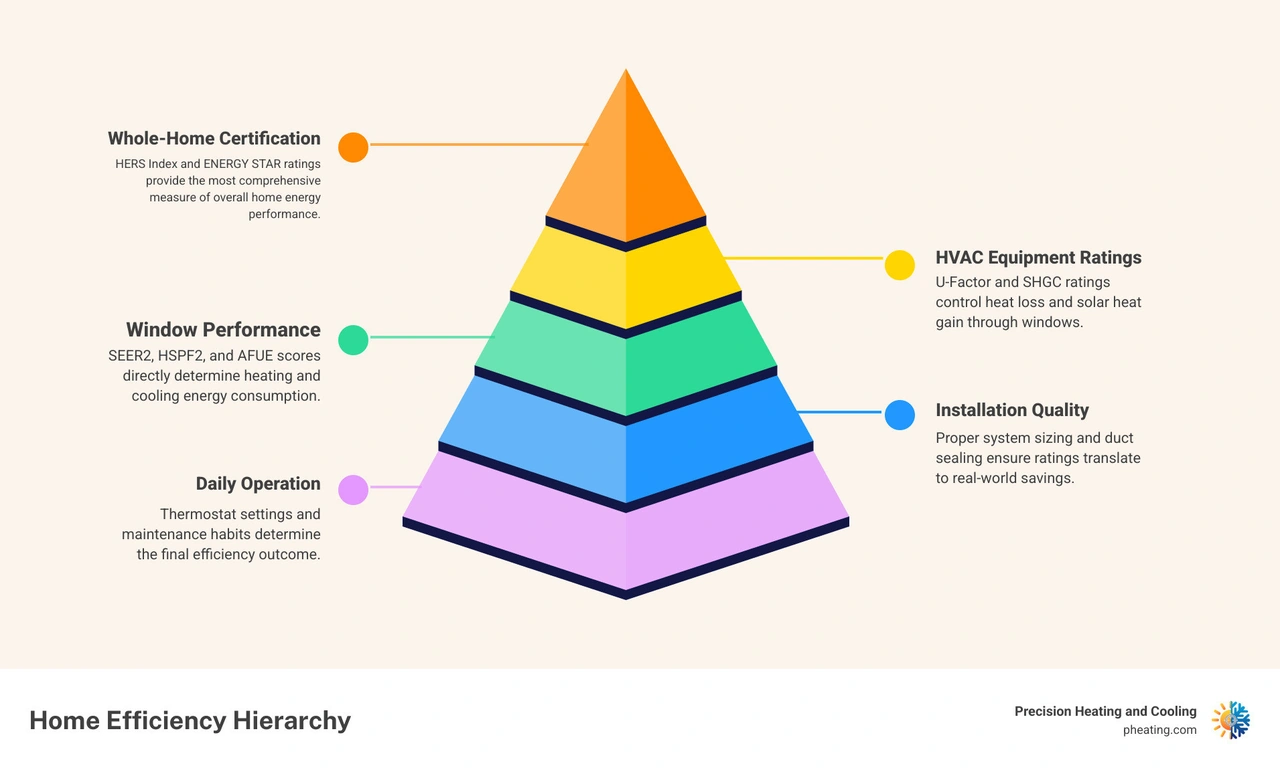
When we look at a home's overall efficiency, we have to look beyond individual pieces of equipment. Whole-home energy certifications provide a comprehensive picture of how well a house retains conditioned air, manages moisture, and utilizes energy. For homeowners in California — from the coastal breezes of Palo Alto and Los Gatos to the warmer summer climates of Clovis and Hanford — these whole-home ratings are incredibly valuable when buying, building, or planning deep energy retrofits.
Understanding these certifications also opens the door to significant financial savings. Knowing how whole-home performance is evaluated makes it much easier to navigate programs like How to Apply for Energy Rebates in California, ensuring you maximize your return on investment.
Developed by the Residential Energy Services Network (RESNET), the Home Energy Rating System (HERS) Index is the industry standard for measuring a home’s overall energy performance. Think of it as a miles-per-gallon (MPG) sticker for an entire house.
The HERS Index operates on a relative scale where a standard new home (built to meet the 2006 International Energy Conservation Code) is assigned a baseline score of 100.
To calculate a HERS score, a certified RESNET HERS Rater must perform an in-depth energy audit. This comprehensive evaluation includes:
By comparing these measurements to a computerized "reference home" of the identical size and shape in the same climate zone, the rater generates a highly accurate, unbiased score.
While the HERS Index provides a numerical score, the ENERGY STAR Certified Home program is a voluntary certification program run by the U.S. Environmental Protection Agency (EPA). To earn this badge, a home must meet strict energy-efficiency guidelines that place it roughly in the top 25% of homes in its category.
ENERGY STAR certified homes require a combination of:
In recent years, the program has evolved to meet the demands of a cleaner grid. Launched in 2024, the ENERGY STAR NextGen certification builds on the classic standard by focusing heavily on decarbonization and electrification. To achieve NextGen status in 2026, a home must feature:
For those looking to transition to highly efficient electric systems, taking advantage of programs like Federal Tax Credits for Heat Pump Upgrades can dramatically lower the cost of making these upgrades.
Additionally, the Department of Energy’s DOE Zero Energy Ready Home (DOE ZERH) program represents the absolute pinnacle of home efficiency. It builds on the ENERGY STAR framework by requiring homes to be so efficient that a modest solar PV system can offset all annual energy use. It also mandates strict adherence to the EPA’s Indoor airPLUS guidelines, ensuring exceptional indoor air quality alongside ultra-low utility bills.
Heating and cooling make up the single largest portion of your home’s energy consumption. When shopping for a new system, you will be presented with a variety of acronyms. Understanding these metrics is the key to choosing a system that balances performance, upfront cost, and long-term operating costs.
In 2023, the Department of Energy officially transitioned to more rigorous testing standards, replacing old metrics with SEER2, HSPF2, and EER2. These updated metrics use a higher external static pressure during laboratory testing to better mimic the real-world resistance of residential duct systems, resulting in ratings that are roughly 4% to 5% lower numerically but far more accurate.
| Metric | What It Stands For | System Type | What It Measures | 2026 California Minimum |
|---|---|---|---|---|
| SEER2 | Seasonal Energy Efficiency Ratio 2 | Air Conditioners & Heat Pumps (Cooling) | Cooling efficiency over an entire season under varying outdoor temperatures. | 14.3 SEER2 |
| EER2 | Energy Efficiency Ratio 2 | Air Conditioners & Heat Pumps (Cooling) | Cooling efficiency at a constant, high outdoor temperature (95°F). | Varies by system type |
| HSPF2 | Heating Seasonal Performance Factor 2 | Heat Pumps (Heating) | Heating efficiency over an entire winter season. | 7.5 to 8.8 HSPF2 |
| AFUE | Annual Fuel Utilization Efficiency | Gas & Oil Furnaces | The percentage of fuel converted directly into usable household heat. | 81% to 90%+ (varies by type) |
When evaluating cooling performance, we look at how much heat a system can remove from your home relative to the electrical energy it consumes.
To get the most out of these ratings, it helps to understand how modern equipment operates. Systems with variable-speed or inverter-driven compressors can modulate their output dynamically, running at lower, highly efficient speeds for most of the day rather than cycling on and off at full blast. If you are planning a system replacement in the Bay Area, consult our Best Heat Pump Installation San Jose Guide to see how these advanced cooling technologies perform in local microclimates.
Heating efficiency is measured differently depending on whether your home uses an electric heat pump or a combustion-based gas furnace.
For many homeowners, the ultimate heating upgrade involves moving to a heat pump system. To learn more about the operational and financial benefits of this transition, check out our guide on the Advantages of Heat Pump Installation.
Windows are often referred to as the "holes in your home’s thermos." No matter how efficient your HVAC system is, poorly insulated windows will allow conditioned air to escape, forcing your heating and cooling equipment to work overtime.
When shopping for replacement windows, look for the National Fenestration Rating Council (NFRC) label, which provides an independent, standardized breakdown of window performance.
Unlike walls, which are rated by their thermal resistance (R-value), windows are evaluated using metrics that measure heat transfer and light transmission.
Replacing old single-pane windows with ENERGY STAR certified double- or triple-pane windows can reduce your home’s overall utility bills by an average of 13%, while significantly reducing draftiness and outdoor noise.
A common mistake homeowners make is assuming that buying a system with a high efficiency label guarantees lower utility bills. In reality, an HVAC unit's yellow EnergyGuide label represents its potential efficiency under perfect laboratory conditions. Once installed, several real-world factors dictate whether the system actually achieves those ratings.
To ensure your home achieves maximum year-round comfort and actualized savings, proper installation is paramount. Learn how professional configuration makes a difference by reading about how to Maximize Comfort with Heat Pump Installation.
If you are buying a newer home or have recently had an energy rating performed, you can find and verify the HERS Index score by accessing the public RESNET National Registry. By entering your home's address, you can view the official certificate, the date of the rating, and the credentials of the certified HERS Rater who conducted the assessment. If your home has never been rated, you can schedule a comprehensive home energy audit with a certified local rater to establish your baseline score.
As of 2026, the Department of Energy enforces regional minimum efficiency standards for all newly installed central air conditioners and heat pumps:
It is illegal for contractors to install equipment below these minimum standards. When replacing an older system, choosing a unit that comfortably exceeds these minimums is highly recommended to protect yourself against rising utility rates.
The savings associated with ENERGY STAR appliances accumulate quickly across your household:
To understand how these advanced water heating systems operate and how they achieve such massive savings, take a look at our detailed breakdown on Heat Pump Water Heater How It Works. For homeowners looking to maximize space and efficiency simultaneously, exploring the Benefits of Tankless Water Heater Installation is another excellent path to lower utility bills.
Navigating efficiency ratings explained for homeowners doesn't have to feel like studying for an engineering exam. By focusing on key metrics like HERS, SEER2, HSPF2, and AFUE, you can make informed decisions that drastically reduce your carbon footprint, improve your indoor air quality, and keep more money in your wallet.
At Precision Heating and Cooling, we bring over two decades of dedicated experience to homeowners throughout the San Jose Bay Area and Central Valley, including Cupertino, Los Gatos, Clovis, Palo Alto, Santa Clara, Sunnyvale, and Hanford. We specialize in designing, installing, and maintaining high-efficiency heating, cooling, and mini-split systems that are perfectly matched to our unique California climates.
If you live in our service area, we can also help you navigate local utility incentives to offset your upfront costs. Learn more about these opportunities in our guide to PG&E Rebates for San Jose Area Homeowners.
Ready to take control of your home’s energy efficiency and enjoy premium comfort? Schedule your consultation with Precision Heating and Cooling today, and let us help you find the perfect high-efficiency solution for your home!

Leslie was amazing for her outstanding customer service skills with me the other day. Thanks to her help my air conditioner is now all set up. She answered all my questions and took away all my problems. Leslie broke it down step by step to set it up easier. Now thanks to her my air conditioner is working perfectly. I really appreciate it Leslie and I’ll be sure to ask for you if I ever come back.
I contacted Precision Heating and Cooling for my home's AC repair. They were punctual and very professional. Guillermo was very kind and thorough. I would highly recommend them!
I am writing to express my sincere appreciation for the excellent work performed by Pablo and Alejandro from Precision Heating and Cooling. Their commitment to quality and customer satisfaction is truly commendable. Awesome job guys!
I would like to extend my sincere gratitude to Alejandro for his exceptional hard work. His passion for helping others is evident, and he consistently goes above and beyond in his service. Alejandro's thorough cleaning of my fireplace has truly made a significant difference. His dedication and professionalism are greatly appreciated.
I was very impressed. Came at night (after 9pm) to fix our AC during the middle of a heat wave the day before a national holiday! Technician was very courteous and efficient, got the job done quickly. Will definitely call them again for any AC servicing I need!
Fast and efficient, arrived when scheduled for repairs and replacement parts were ordered and installed quickly. Techs were very friendly and professional. AC system works great now! I highly recommend their services if you need repairs. Tim




.avif)
