


.avif)







Recent Blogs
Stay updated with our latest blog posts.


Understanding how HVAC load calculations work is the first step toward making sure your home stays comfortable year-round without wasting energy or money. At its core, an HVAC load calculation is a detailed analysis that determines exactly how much heating and cooling your home needs — not a rough guess, but a precise figure based on your home's specific characteristics.
Here is a quick overview of how the process works:
Getting this process right matters more than most homeowners realize. An oversized system short-cycles — it blasts cold or warm air and shuts off before finishing the job, leaving humidity uncontrolled and components wearing out faster. An undersized system runs nearly nonstop, driving up energy bills and struggling to keep up on the hottest or coldest days. Neither extreme is acceptable, which is why precise load calculations are the foundation of any well-designed HVAC system.
My name is Tony Lara, and through my hands-on work in the HVAC field I have seen how proper load calculations make the difference between a system that performs flawlessly and one that causes constant problems — understanding how HVAC load calculations work is something I am deeply passionate about sharing. Let's walk through the full process so you know exactly what to expect.
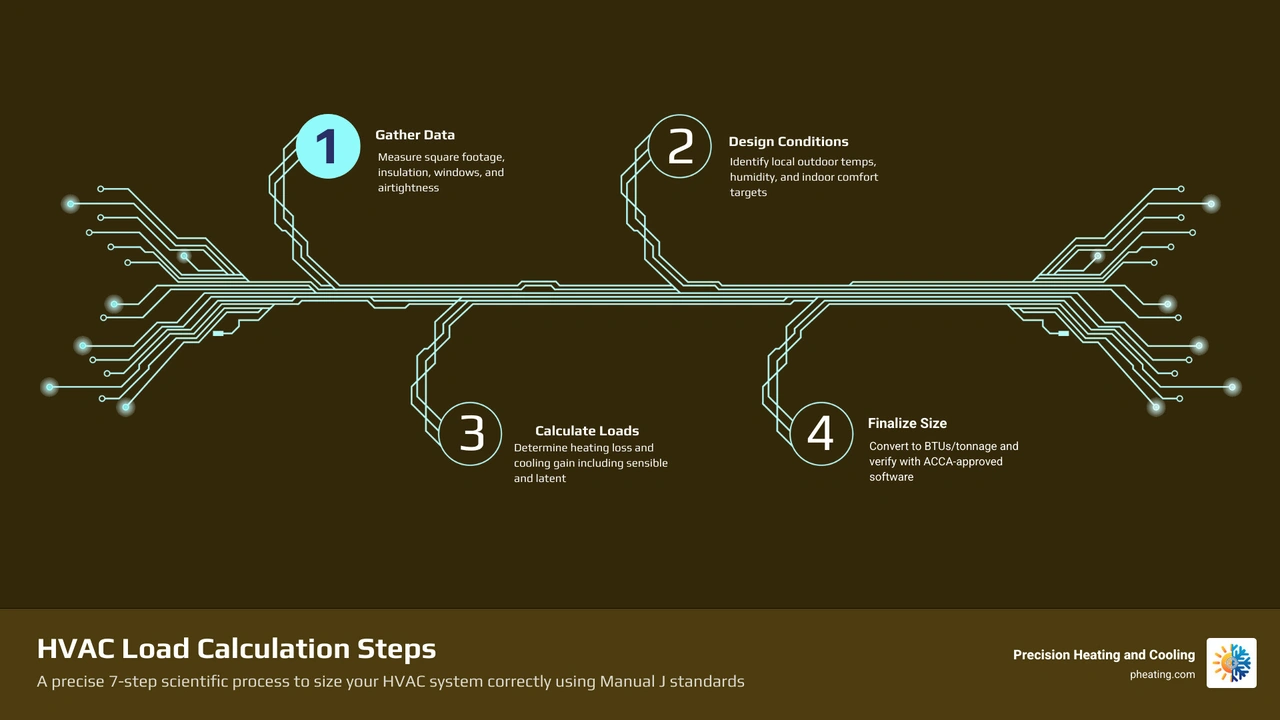
At its simplest, an HVAC load calculation is the scientific method we use to determine the thermal energy required to keep a home comfortable. We don't just eyeball a house or guess based on how many bedrooms it has. Instead, we perform a detailed analysis of the home's structure, climate, and usage patterns.
To understand why this matters, we first need to define a few key terms:
When we install a new climate control system, we aim for the "Goldilocks" zone—not too big, not too small, but just right.
If a system is oversized, it will suffer from a phenomenon called short-cycling. The unit turns on, quickly blasts the home with conditioned air, and turns off before it can complete a full, efficient cycle. Because it runs in short bursts, it never has enough time to pull moisture out of the air, leaving your home feeling cold and clammy. This constant starting and stopping also wastes energy and places immense stress on the compressor, leading to premature system failure. If you are experiencing this with your current unit, it might be time to read our guide on When to Consider Heat Pump Replacement Services.
Conversely, an undersized system will run almost continuously on hot summer afternoons or cold winter nights. Because it lacks the capacity to meet the thermal load, your home will never quite reach the temperature set on your thermostat. This constant operation leads to soaring energy bills and rapid wear and tear on the system's mechanical parts.
Whether you are building a new property or looking into a Heat Pump Installation for Your Home, starting with an accurate load calculation ensures you get a system that runs efficiently, keeps your utility bills low, and maintains perfect indoor comfort.
The gold standard for residential sizing is the Manual J calculation. Developed by the Air Conditioning Contractors of America (ACCA), Manual J is an engineering protocol that quantifies the exact rate of heat transfer into and out of a building.
To understand how hvac load calculations work under the Manual J standard, we have to look at the physics of heat. Heat naturally moves from warmer areas to cooler areas. In the winter, heat escapes from your warm living room to the cold outdoors. In the summer, outdoor heat forces its way into your cool home.
This thermal exchange involves two distinct types of heat loads:
When we calculate a home’s heating load, we are measuring heat loss. This is the rate at which thermal energy escapes through the building envelope during the coldest days of the year.
Heat loss occurs primarily through conduction—heat traveling directly through solid materials like your walls, ceiling, and windows. To calculate conduction, we use two critical values:
To see this in action, let's look at a quick engineering example. For a 10 ft² building section with a single glass window (which has a high U-value of 1.13) and a 70°F temperature difference between the inside and outside, the heat loss is calculated as:
$$\text{Heat Loss} = \text{Area} \times \text{U-value} \times \text{Temperature Difference}$$$$\text{Heat Loss} = 10 \text{ ft}^2 \times 1.13 \times 70^\circ\text{F} = 791 \text{ Btu/h}$$
By calculating this for every wall, window, door, and ceiling, we determine exactly how many BTUs your heating system must produce to keep your home warm.
Calculating the cooling load is all about measuring heat gain—the rate at which thermal energy enters and builds up inside your home during the summer.
Cooling calculations are highly dynamic because heat enters your home in several ways:
To account for both sensible and latent heat, engineers and advanced HVAC software utilize psychrometrics—the study of the physical and thermodynamic properties of moist air.
Using a psychrometric chart, we can map out variables like dry-bulb temperature (the air temperature measured by a standard thermometer), wet-bulb temperature (which accounts for evaporative cooling), and relative humidity.
For optimal comfort, the industry standard suggests maintaining specific indoor ranges:
By analyzing these psychrometric properties, we can determine the exact volume of airflow needed. A typical HVAC system produces 400 CFM (cubic feet per minute) per ton of air conditioning. This design volume flow rate ensures that the system has enough capacity to handle both the sensible cooling of the air and the latent dehumidification of the space.
Historically, many HVAC contractors relied on a simple "rule of thumb" to size systems, such as allocating 1 ton of cooling for every 400 to 500 square feet of living space. While this was an easy shortcut, it is incredibly inaccurate and frequently leads to severe oversizing or undersizing.
Modern energy-efficient homes built in Palo Alto or Sunnyvale require far less heating and cooling capacity than an older home of the exact same size in Hanford or Clovis. A rule-of-thumb estimate completely ignores local climate variations, insulation quality, window performance, and home orientation.
For example, a home with extensive south-facing glass in full sun will have a drastically higher cooling load than an identical home shaded by mature redwood trees. If you are planning an upgrade in the South Bay, referencing a specialized guide like our Best Heat Pump Installation San Jose Guide can help you understand how professional sizing applies to our local microclimates.
To see just how much these methods differ, look at this comparison table:
| Home Characteristic | Rule of Thumb Estimate (1 Ton per 500 sq. ft.) | Precise Manual J Load Calculation | Real-World Performance Impact |
|---|---|---|---|
| 1,500 sq. ft. Home (Older, poor insulation, single-pane windows) | 3.0 Tons (36,000 Btu/h) | 3.5 Tons (42,000 Btu/h) | Undersized: If sized by rule of thumb, the system will run constantly and fail to cool the home on hot days. |
| 1,500 sq. ft. Home (Modern, high-efficiency insulation, double-pane windows) | 3.0 Tons (36,000 Btu/h) | 2.0 Tons (24,000 Btu/h) | Oversized: If sized by rule of thumb, the system will short-cycle, leading to high humidity and premature wear. |
| 2,500 sq. ft. Home (Standard construction, moderate shade) | 5.0 Tons (60,000 Btu/h) | 3.5 Tons (42,000 Btu/h) | Oversized: A 5-ton system is far too large, leading to high energy bills and uneven temperatures. |
When we perform a professional Manual J calculation, we evaluate your home's entire building envelope—the physical barrier that separates the conditioned indoor air from the unconditioned outdoor environment.
Several critical factors influence this thermal load:
Because upgrading these components directly reduces your heating and cooling loads, doing so can allow you to install a smaller, less expensive HVAC system. Even better, homeowners in California can take advantage of substantial financial incentives for these upgrades. Be sure to explore the available California Energy Rebates for HVAC Upgrades as well as the Federal Tax Credits for Heat Pump Upgrades to see how you can save on your next project.
Sometimes, in an attempt to play it safe, inexperienced contractors will artificially inflate design inputs or add arbitrary "safety factors" to a load calculation. They might assume the attic has no insulation or ignore the fact that the home has high-performance double-pane windows.
This practice is highly discouraged. According to the ACCA Manual J standard, load calculations should be aggressive and based strictly on real, verified data.
When multiple safety factors are stacked on top of each other, the calculated cooling load can easily inflate by 45% to over 160%. For instance, a home that actually requires a 2.5-ton system might end up with a 4-ton or 5-ton unit specified.
The consequences of this load inflation include:
To protect your investment and ensure your system continues to run as efficiently as the day it was installed, we always recommend keeping up with scheduled service. You can learn more about this in our guide on the Benefits of Regular Heat Pump Maintenance.
Sensible heat load refers to the dry heat energy required to change the actual temperature of the indoor air (which you can read on a thermometer). Latent heat load refers to the energy required to remove moisture (humidity) from the air. In warm, humid climates, an HVAC system must spend a significant portion of its capacity on latent heat removal (dehumidification) to make the air feel comfortable.
Outdoor design temperatures are not the absolute extreme historic highs or lows for a region. Instead, they are statistical thresholds published by ASHRAE (such as the 1% cooling design temperature, which is exceeded for only 88 hours of an average year). Sizing a system for a once-in-a-decade extreme temperature would result in a heavily oversized system for the other 99% of the year.
An online calculator is a great tool for getting a rough, ballpark estimate of your heating and cooling needs. However, it should never be used for final equipment selection. A licensed HVAC professional must perform an on-site inspection to verify insulation levels, ductwork integrity, building airtightness, and local microclimate factors using certified ACCA Manual J software.
At Precision Heating and Cooling, we believe that a comfortable home starts with precise engineering. Understanding how HVAC load calculations work shows why "rules of thumb" simply don't cut it when it comes to modern home comfort and energy efficiency.
Whether you reside in the South Bay—including Cupertino, Los Gatos, Palo Alto, Santa Clara, and Sunnyvale—or down in the Central Valley around Hanford and Clovis, our team brings more than two decades of hands-on experience to every project. We never guess on system sizing. We perform rigorous, accurate load calculations to ensure your new heat pump or air conditioner is sized perfectly for your unique home.
If you are ready to experience the comfort and savings of a perfectly sized heating and cooling system, contact us today to learn more about our comprehensive Precision Heating and Cooling HVAC Services.

Leslie was amazing for her outstanding customer service skills with me the other day. Thanks to her help my air conditioner is now all set up. She answered all my questions and took away all my problems. Leslie broke it down step by step to set it up easier. Now thanks to her my air conditioner is working perfectly. I really appreciate it Leslie and I’ll be sure to ask for you if I ever come back.
I contacted Precision Heating and Cooling for my home's AC repair. They were punctual and very professional. Guillermo was very kind and thorough. I would highly recommend them!
I am writing to express my sincere appreciation for the excellent work performed by Pablo and Alejandro from Precision Heating and Cooling. Their commitment to quality and customer satisfaction is truly commendable. Awesome job guys!
I would like to extend my sincere gratitude to Alejandro for his exceptional hard work. His passion for helping others is evident, and he consistently goes above and beyond in his service. Alejandro's thorough cleaning of my fireplace has truly made a significant difference. His dedication and professionalism are greatly appreciated.
I was very impressed. Came at night (after 9pm) to fix our AC during the middle of a heat wave the day before a national holiday! Technician was very courteous and efficient, got the job done quickly. Will definitely call them again for any AC servicing I need!
Fast and efficient, arrived when scheduled for repairs and replacement parts were ordered and installed quickly. Techs were very friendly and professional. AC system works great now! I highly recommend their services if you need repairs. Tim




.avif)
