


.avif)






Recent Blogs
Stay updated with our latest blog posts.


Knowing when to repair vs replace your HVAC system can be the difference between a smart investment and throwing money at a unit that's already on its way out. As a homeowner in the San Jose Bay Area, your HVAC system works hard year-round — and when something goes wrong, the pressure to make a quick decision can lead to costly mistakes in either direction.
Here's a quick-reference guide to help you decide:
| Situation | Repair or Replace? |
|---|---|
| System is under 10 years old (AC/heat pump) or under 15 years (furnace) with a minor issue | Repair |
| Repair cost × system age is under $5,000 | Repair |
| Repair cost is less than 50% of a new system's cost | Repair |
| System is over 10 years old (AC/heat pump) or over 15 years (furnace) with a major failure | Replace |
| Repair cost × system age exceeds $5,000 | Replace |
| System uses R-22 (Freon) refrigerant | Replace |
| Cracked heat exchanger or carbon monoxide risk detected | Replace immediately |
| 3 or more repairs in the past 3 years | Replace |
| Energy bills have risen 20–40% without explanation | Replace |
Most homeowners face this decision at the worst possible time — when the AC fails during a summer heatwave or the furnace goes out on a cold January night. The goal of this guide is to give you a clear, calm framework so you're never caught off guard.
I'm Tony Lara, an HVAC professional with hands-on experience helping homeowners navigate exactly these kinds of decisions about when to repair vs replace your HVAC system, from tracking down hard-to-find parts to evaluating whether a struggling system is worth saving. In the sections ahead, I'll walk you through the key rules, warning signs, and financial factors that make this decision straightforward.
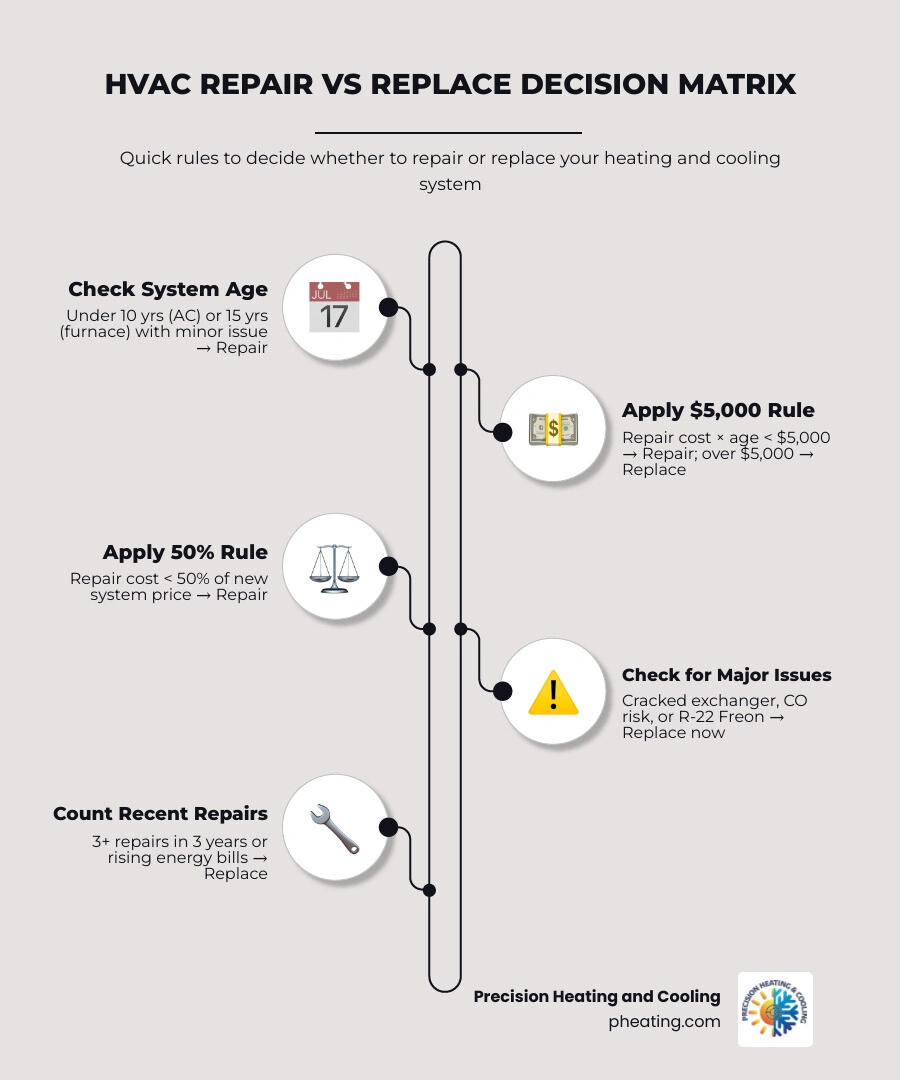
When you are staring at a broken heater or a blowing air conditioner that is only circulating warm air, it is easy to let panic guide your decision. To keep things objective, the HVAC industry relies on two primary financial rules of thumb: the $5,000 rule and the 50% rule.
These mathematical models help remove emotion from the equation, allowing you to look at your system as a long-term investment. They are particularly useful when deciding When Is the Right Time to Replace Your Heater or air conditioner.
The $5,000 rule is a widely accepted industry formula that evaluates the economic viability of a repair based on the age of your equipment.
To use this formula:
If the resulting number is under 5,000, a repair is generally the most sensible financial decision. If the result exceeds 5,000, the math strongly suggests that your money is better spent on a brand-new system.
For example, if you have an 8-year-old air conditioner that needs a minor electrical repair, multiplying its age by the modest repair cost will yield a number well under the 5,000 threshold. Repairing the unit is a no-brainer. However, if you have a 14-year-old system facing a substantial component replacement, multiplying 14 by that high repair cost will easily push you past the 5,000 mark. In that scenario, investing in a replacement is the smarter long-term move.
The 50% rule is even simpler: never spend more than half the cost of a new system on a single repair.
If your system experiences a catastrophic failure—such as a seized compressor or a rusted-out evaporator coil—and the quote to fix it is more than 50% of what a modern, high-efficiency replacement would cost, you should transition from a repair mindset to a replacement plan.
Paying for an expensive repair on an older, out-of-warranty system is often just subsidizing its slow demise. You might fix the compressor today, only to have the fan motor fail next season, leaving you trapped in a costly cycle of endless repairs.
Not every system breakdown requires a trip to the equipment showroom. In fact, many common HVAC issues are entirely minor and highly fixable. If your system is relatively young, has been regularly maintained, and has otherwise kept your home comfortable, a professional repair is almost always the right path.
Paying attention to early Warning Signs Your AC Needs Repair can prevent small, inexpensive problems from snowballing into catastrophic system failures.
Just like a car needs new spark plugs or brake pads over time, an HVAC system has several electrical and mechanical "wear items" that are designed to be replaced periodically. These parts are relatively inexpensive and simple to swap out.
To ensure these small components don't fail when you need them most, it helps to understand How Often Should You Service Your HVAC System to catch wear and tear early.
If your system is experiencing performance issues but is otherwise structurally sound, a targeted repair can restore it to peak performance.
If your system suddenly stops working entirely, consulting an Emergency HVAC Repair Complete Guide can help you troubleshoot basic power and thermostat settings before calling in the professionals.
While we always look for ways to extend the life of your existing equipment, there are certain situations where repairing a system is either physically impossible, financially reckless, or downright dangerous. Recognizing these critical red flags will help you make a decisive choice when evaluating Factors to Consider Before a Heater Replacement.
Safety should always be your absolute top priority. Gas-fired furnaces rely on a metal component called a heat exchanger to safely separate toxic combustion gases—including deadly carbon monoxide (CO)—from the clean air circulating through your home's ductwork.
As a furnace ages, the constant expansion and contraction of the metal can cause the heat exchanger to crack. A cracked heat exchanger is a severe safety hazard because it allows carbon monoxide to leak directly into your living spaces.
If a licensed technician discovers a cracked heat exchanger or a severe gas leak during an inspection, immediate replacement is the only safe option. We will legally disable the system to protect your family, and continuing to run or attempt a patch repair on a cracked heat exchanger is never permitted.
If your air conditioner or heat pump was installed before 2010, there is a very high probability that it utilizes R-22 refrigerant (commonly known as Freon). Due to international environmental regulations aimed at protecting the ozone layer, the production and import of R-22 has been completely phased out.
As of June 2026, the remaining supply of recycled R-22 is incredibly scarce, making the cost to recharge an older system astronomical. If your older R-22 system develops a refrigerant leak, attempting a repair is a temporary patch on a sinking ship.
Between the high cost of the repair itself and the extreme expense of sourcing R-22 refrigerant, investing that money into a modern system that uses eco-friendly, readily available refrigerants is the only logical financial decision.
Certain core components are considered the "heart" of your HVAC system. When these fail on an aging, out-of-warranty unit, it is usually a sign of systemic decline.
When comparing the cost of a major repair to a full system replacement, many homeowners look only at the upfront price tag. However, the true cost of ownership includes your monthly utility bills over the next decade.
Upgrading an older, inefficient system to a modern, high-efficiency model can reduce your monthly heating and cooling energy consumption by 20% to 40%, according to the Department of Energy.
Here is how modern efficiency ratings compare to older systems:
| System Component | Older Standard Ratings | Modern Minimum Standards (2026) | High-Efficiency Options | Potential Energy Savings |
|---|---|---|---|---|
| Air Conditioning (SEER2) | 8 - 10 SEER | 13.4 - 14.3 SEER2 | 16 - 22+ SEER2 | 20% - 40% savings |
| Gas Furnace (AFUE) | 60% - 70% AFUE | 80% AFUE | 95% - 98% AFUE | 25% - 35% savings |
| Heat Pump (HSPF2 / SEER2) | 6.0 - 7.0 HSPF | 7.5 - 8.8 HSPF2 | 9.0 - 10.5+ HSPF2 | 20% - 30% savings |
By upgrading to an ENERGY STAR qualified system, you unlock even greater long-term value. ENERGY STAR certified furnaces are 15% more efficient than conventional new models, while qualified boilers offer a 5% efficiency boost over standard new systems.
Furthermore, you can significantly offset the upfront investment of a new system through:
The typical lifespan of heating and cooling equipment varies by system type, usage patterns, and how well it has been maintained:
If both components are over 12 years old, yes, it is highly recommended to replace them simultaneously.
Because your furnace and air conditioner share the same blower motor and duct system, they are designed to work together as a matched set. Pairing a brand-new, high-efficiency outdoor AC condenser with an old, inefficient indoor furnace blower is like putting a sports car engine into an old station wagon—it limits the efficiency gains and can cause premature wear on the new component.
Additionally, replacing both units at the same time saves you thousands of dollars in combined labor costs compared to doing them separately.
Climate plays a massive role in equipment wear. In milder coastal areas of the San Jose Bay Area (like Palo Alto, Sunnyvale, Cupertino, and Los Gatos), systems experience moderate runtimes, allowing them to often reach the upper limits of their expected lifespans.
However, in the hotter Central Valley regions (such as Clovis and Hanford), air conditioners run nonstop during intense summer heatwaves. This extreme thermal stress accelerates component wear, meaning a system in Hanford or Clovis may need replacement 3 to 5 years earlier than an identical system operating in a cooler coastal climate.
Deciding when to repair vs replace your HVAC system doesn't have to be a stressful guessing game. By applying clear industry rules, keeping an eye out for critical safety hazards, and factoring in long-term monthly energy savings, you can make a confident, evidence-based decision that protects both your family's comfort and your household budget.
At Precision Heating and Cooling, we bring over two decades of dedicated experience to homeowners throughout the San Jose Bay Area and the Central Valley. Whether you need an honest second opinion on a major repair or are ready to explore a high-efficiency system upgrade, our team is here to provide reliable service, competitive pricing, and flexible payment options tailored to your needs.
If you live in Cupertino, Los Gatos, Clovis, Palo Alto, Santa Clara, Sunnyvale, or Hanford, contact us today to schedule a comprehensive system evaluation and find the perfect comfort solution for your home.

Leslie was amazing for her outstanding customer service skills with me the other day. Thanks to her help my air conditioner is now all set up. She answered all my questions and took away all my problems. Leslie broke it down step by step to set it up easier. Now thanks to her my air conditioner is working perfectly. I really appreciate it Leslie and I’ll be sure to ask for you if I ever come back.
I contacted Precision Heating and Cooling for my home's AC repair. They were punctual and very professional. Guillermo was very kind and thorough. I would highly recommend them!
I am writing to express my sincere appreciation for the excellent work performed by Pablo and Alejandro from Precision Heating and Cooling. Their commitment to quality and customer satisfaction is truly commendable. Awesome job guys!
I would like to extend my sincere gratitude to Alejandro for his exceptional hard work. His passion for helping others is evident, and he consistently goes above and beyond in his service. Alejandro's thorough cleaning of my fireplace has truly made a significant difference. His dedication and professionalism are greatly appreciated.
I was very impressed. Came at night (after 9pm) to fix our AC during the middle of a heat wave the day before a national holiday! Technician was very courteous and efficient, got the job done quickly. Will definitely call them again for any AC servicing I need!
Fast and efficient, arrived when scheduled for repairs and replacement parts were ordered and installed quickly. Techs were very friendly and professional. AC system works great now! I highly recommend their services if you need repairs. Tim



.avif)
