


.avif)






Recent Blogs
Stay updated with our latest blog posts.


Should I repair or replace my HVAC system is one of the most stressful questions you can face as a homeowner — especially when it happens on the hottest day of a San Jose summer or during a Central Valley heat wave. The answer isn't always obvious, and making the wrong call can cost you thousands of dollars in either wasted repairs or an unnecessary replacement.
Here's a quick framework to guide your decision:
| Situation | Likely Best Choice |
|---|---|
| System is under 10 years old, minor repair needed | Repair |
| System is 10-15 years old, moderate repair cost | Evaluate with $5,000 Rule |
| System is 15+ years old, major component failure | Replace |
| Repair cost exceeds 50% of new system price | Replace |
| Safety issue (carbon monoxide, gas leak) | Replace immediately |
| System uses R-22 refrigerant, major repair needed | Replace |
| Three or more repairs in the last three years | Replace |
The core decision comes down to a handful of factors: how old your system is, what it will cost to fix, how often it has broken down, and how efficiently it runs today compared to what a modern unit could deliver. Get those factors right, and the answer usually becomes clear.
In this guide, we'll walk you through each one — with real decision rules, efficiency benchmarks, and safety considerations — so you can make a confident, informed choice for your home.
I'm Tony Lara, an HVAC professional with hands-on experience helping homeowners navigate exactly this kind of decision, including when should I repair or replace my HVAC system becomes more than just a question — it becomes urgent. My passion for tracking down hard-to-find parts and solving complex system problems gives me a practical edge in helping you weigh every option honestly.
When your air conditioner or furnace stops working in the middle of a heatwave, emotions can run high. To help you stay objective, the industry uses two "Golden Rules" that remove the guesswork from the equation. These rules provide a mathematical foundation for deciding whether to invest in HVAC Repair San Jose CA or commit to an HVAC Replacement San Jose CA.
Most residential HVAC systems are designed to last between 15 and 20 years. However, as a system enters its second decade, the "economic viability" of repairs begins to drop. We often see a "domino effect" where one major part fails, followed quickly by others due to systemic fatigue. By using specific financial thresholds, you can avoid the trap of pouring money into a "sunk cost."
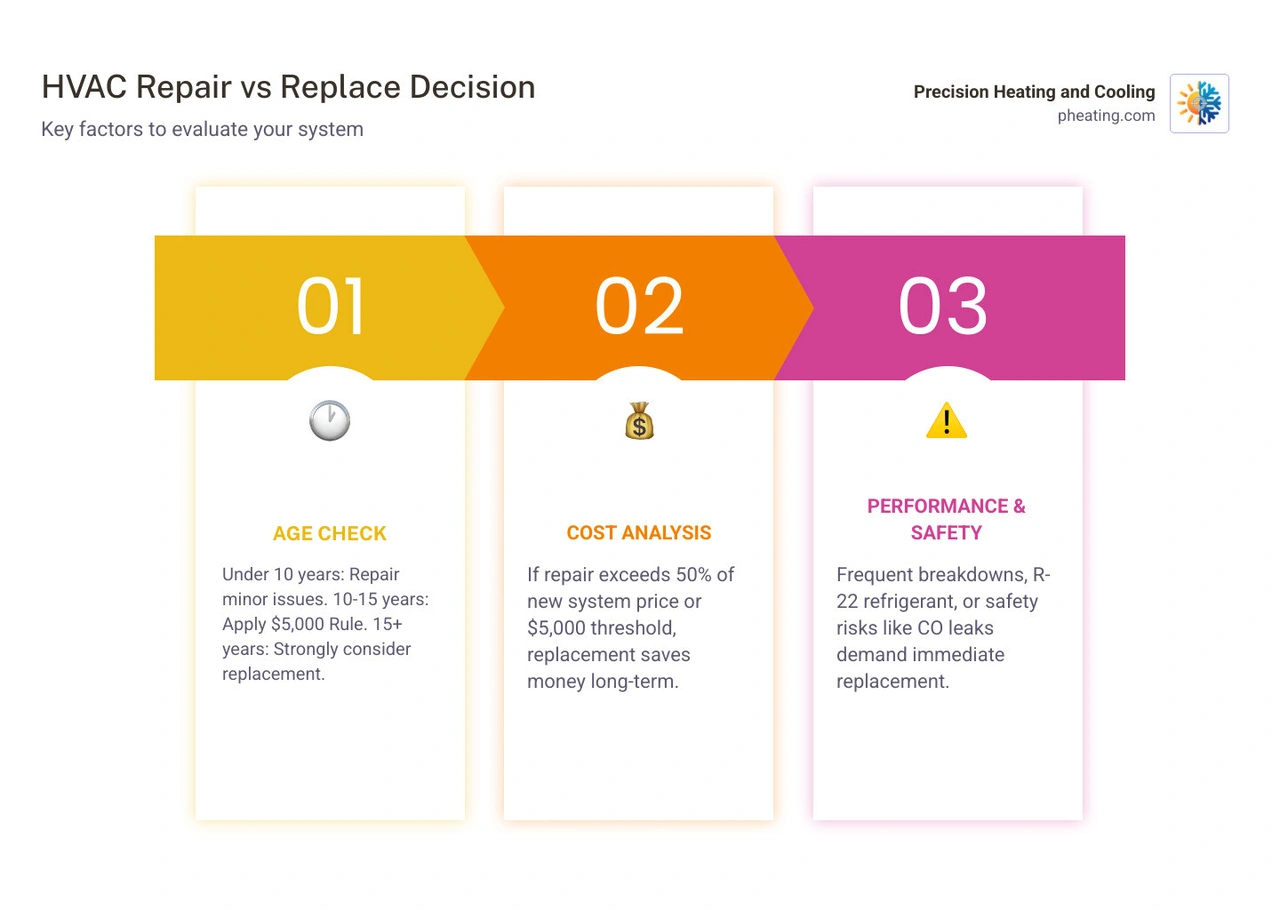
One of the most reliable tools in our industry is the $5,000 Rule. It’s a simple math formula: multiply the age of your unit by the total repair quote. If the result is over $5,000, you should replace the unit. If it’s under $5,000, a repair is likely a safe bet.
For example, if you have a 12-year-old system and the repair is quoted at $500, your total is $6,000. Under this rule, replacement is the smarter long-term financial move. Conversely, a $200 repair on an 8-year-old system ($1,600 total) is a clear "repair" scenario. This logic helps you see that as a unit gets older, even smaller repairs become less justifiable.
Another benchmark we use is the 50% Rule. This rule states that if the cost of a single repair exceeds 50% of the price of a brand-new system, you should opt for the upgrade. This is particularly relevant when dealing with major component failures like a cracked heat exchanger or a seized compressor.
When you are facing a massive repair bill for an out-of-warranty unit, you aren't just paying for the part; you are paying to keep an old, inefficient machine on life support. By choosing HVAC Replacement Sunnyvale CA instead of a high-priced HVAC Repair Sunnyvale CA, you gain a fresh manufacturer’s warranty and significantly lower energy bills, which often pays for the difference in cost over just a few years.
Age is the most significant risk factor for any mechanical system. While a well-maintained furnace can sometimes stretch to 20 years, air conditioners and heat pumps typically start showing their age after 10 to 12 years. ENERGY STAR benchmarks suggest that if your AC is over 10 years old or your furnace is over 15, it’s time to start planning for the future.
In our experience serving the Bay Area, we’ve found that systems in the Central Valley often age "faster" than those in milder coastal pockets because they run for longer cycles during extreme heat. If you find yourself frequently calling for HVAC Service Santa Clara CA, you are likely dealing with a system that has reached its "retirement age," making HVAC Replacement Santa Clara CA the more reliable path.
Beyond the calendar, your home will often tell you when it's time for a change. Watch for these performance red flags:
If you are constantly booking an HVAC Repair Hanford CA, you might be better served by consulting a local HVAC Company Hanford CA to discuss a modern, high-efficiency setup.
As of May 2026, the type of refrigerant your system uses is a massive factor in the "repair vs. replace" debate. Older systems (typically those manufactured before 2010) use R-22 refrigerant, commonly known as Freon. The EPA has phased this out because of its ozone-depleting properties.
Because R-22 is no longer produced, the cost to "recharge" a system with a leak is now astronomically high. We often tell homeowners that if an R-22 system has a major leak or a failed compressor, it is a "losing proposition" to fix it. Switching to a modern unit that uses eco-friendly R-410A or newer alternatives like R-454B is often the only logical choice for an HVAC Replacement Clovis CA.
Modern HVAC technology has advanced significantly in the last decade. Today's systems aren't just quieter; they are engineered to use far less energy. When considering should I repair or replace my HVAC system, you must look at the "hidden costs" of keeping an old unit—specifically your monthly utility bills and your home's safety.
| Rating Type | What it Measures | Older Standard | Modern High-Efficiency |
|---|---|---|---|
| SEER2 | Cooling Efficiency | 10 - 13 | 16 - 22+ |
| AFUE | Heating Efficiency | 80% | 95% - 98% |
| HSPF2 | Heat Pump Efficiency | 7.5 | 9.0 - 11.0 |
Upgrading to high-efficiency equipment in HVAC Replacement Palo Alto CA can be more affordable than you think. While an HVAC Tune Up Palo Alto CA is great for maintenance, it won't provide the massive energy savings that come with a new unit. Plus, current federal tax credits under the Inflation Reduction Act offer up to $2,000 for qualifying heat pumps, making the jump to new tech much more appealing.
There are some scenarios where the "repair" option is completely off the table for safety reasons. At a reputable HVAC Company Cupertino CA, we prioritize your family's health above all else.
The jump in efficiency between an old SEER 9 unit and a modern SEER 16 unit can reduce your cooling electricity consumption by more than 35%. In the San Jose area, where electricity rates are a significant monthly expense, these savings add up quickly.
If your furnace is over 15 years old, an ENERGY STAR-qualified model can be 15% more efficient than a standard new model, and significantly more efficient than your current aging unit. While we always recommend an HVAC Tune Up Los Gatos CA to keep things running, if your bills are out of control, an HVAC Replacement Los Gatos CA is the only way to permanently lower those costs.
Your HVAC system is one of the most expensive assets in your home. Decisions shouldn't just be about fixing a broken part; they should be about your long-term goals for the property. For example, if you’ve recently added a room or a home office, your old system might now be "undersized." An undersized system will run non-stop, wear out prematurely, and never truly keep you comfortable.
Regular San Jose HVAC Maintenance can extend the life of a unit, but it can't change the underlying physics of an aging or poorly sized system. Modern replacements also offer variable-speed technology, which allows the system to run at lower, quieter speeds most of the time, dramatically improving indoor air quality and comfort.
If you plan to sell your home in the next year or two, the decision gets a bit more nuanced. Generally, if the system is functional and safe, a repair is often the better choice for your immediate ROI. However, if the system is over 15 years old, it will likely be flagged during a buyer's home inspection.
A brand-new HVAC system is a powerful selling point. It gives potential buyers peace of mind that they won't face a major expense immediately after moving in. If you are unsure, consulting a professional HVAC Company for an honest assessment can help you decide which path will lead to a smoother closing.
We use the "3-in-3" rule. If your system has required three or more significant repairs in the last three years, it is telling you that its components are failing in a "domino effect." At this stage, the cumulative cost of service calls and parts often approaches the down payment on a much more reliable new system.
While it’s technically possible to replace just one half of a split system, it is rarely recommended. Modern indoor and outdoor units are designed to work together as a matched set. Mixing a new, high-efficiency outdoor condenser with an old, dirty indoor coil will "strangle" the new unit’s efficiency, likely void its warranty, and lead to premature failure.
Before you sign off on a major repair, ask your technician:
Deciding should I repair or replace my HVAC system doesn't have to be a guessing game. By applying the $5,000 rule, checking your system's age, and considering the long-term energy savings of modern technology, the right path usually reveals itself. Whether you need a precision fix to get through the season or a full system upgrade to transform your home's comfort, our team is here to help.
At Precision Heating and Cooling, we bring over two decades of experience to every home in the San Jose Bay Area and Central Valley. We pride ourselves on providing honest, expert assessments that prioritize your comfort and budget. If you're standing at the HVAC crossroads, don't go it alone. Contact us at our HVAC Company today for a professional evaluation and a solution you can trust.

Leslie was amazing for her outstanding customer service skills with me the other day. Thanks to her help my air conditioner is now all set up. She answered all my questions and took away all my problems. Leslie broke it down step by step to set it up easier. Now thanks to her my air conditioner is working perfectly. I really appreciate it Leslie and I’ll be sure to ask for you if I ever come back.
I contacted Precision Heating and Cooling for my home's AC repair. They were punctual and very professional. Guillermo was very kind and thorough. I would highly recommend them!
I am writing to express my sincere appreciation for the excellent work performed by Pablo and Alejandro from Precision Heating and Cooling. Their commitment to quality and customer satisfaction is truly commendable. Awesome job guys!
I would like to extend my sincere gratitude to Alejandro for his exceptional hard work. His passion for helping others is evident, and he consistently goes above and beyond in his service. Alejandro's thorough cleaning of my fireplace has truly made a significant difference. His dedication and professionalism are greatly appreciated.
I was very impressed. Came at night (after 9pm) to fix our AC during the middle of a heat wave the day before a national holiday! Technician was very courteous and efficient, got the job done quickly. Will definitely call them again for any AC servicing I need!
Fast and efficient, arrived when scheduled for repairs and replacement parts were ordered and installed quickly. Techs were very friendly and professional. AC system works great now! I highly recommend their services if you need repairs. Tim



.avif)
