


.avif)





Recent Blogs
Stay updated with our latest blog posts.


Knowing the signs you need emergency HVAC service could be the difference between a quick fix and a full system failure — or worse, a safety crisis in your home. Here's a fast answer if you need it right now:
Signs you need emergency HVAC service:
Your HVAC system is one of the hardest-working systems in your home, and it almost never picks a convenient time to fail. In fact, over 70% of homeowners experience an HVAC breakdown during peak seasons — exactly when you need the system most. During a Bay Area summer heat wave or a cold Central Valley night, what starts as a strange noise or an odd smell can escalate into a safety emergency within hours.
Not every HVAC issue demands a midnight call. But some absolutely do. The challenge most homeowners face is knowing which is which — and acting fast enough when it counts.
I'm Tony Lara, an HVAC professional with hands-on experience diagnosing the kind of system failures that show up as the signs you need emergency HVAC service. My background in technical troubleshooting and parts sourcing has given me a front-row seat to what happens when early warning signs get ignored — and I'm here to help you avoid that.
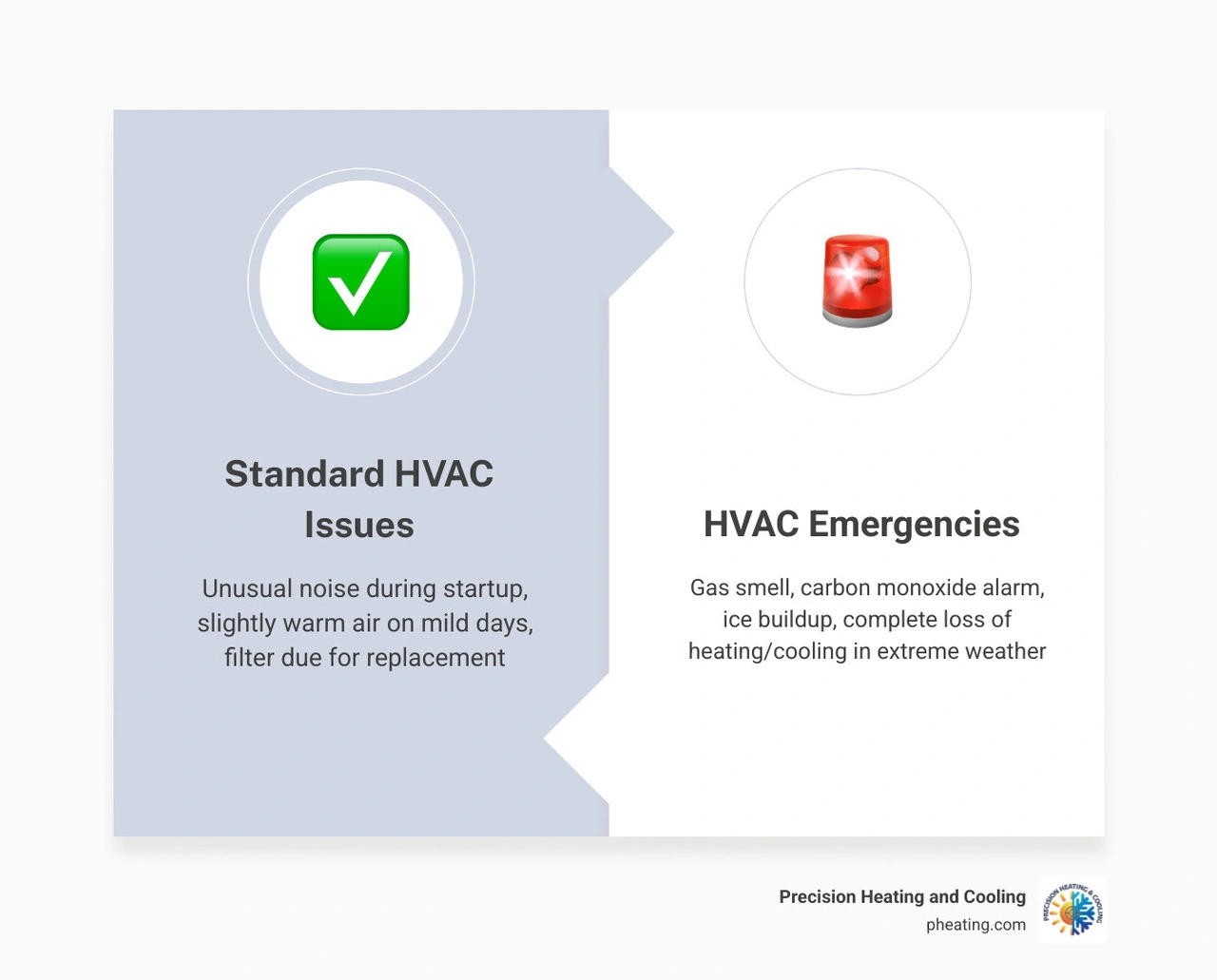
Quick signs you need emergency hvac service definitions:
As we navigate the climate extremes of June 2026, distinguishing between a routine repair and a true HVAC emergency is crucial. An HVAC emergency is defined by any scenario that poses an immediate threat to your health, your safety, or the structural integrity of your property.
To help homeowners make this decision quickly, we often refer to the 90/40 rule.
While a well-insulated modern home has a "thermal mass" that can retain a safe indoor temperature for about 8 to 12 hours after a system failure, that safety window shrinks rapidly in extreme weather. Furthermore, certain vulnerable residents—such as infants, the elderly, and individuals with chronic medical conditions—cannot handle sudden temperature spikes or drops. For these households, a system breakdown in extreme weather is an immediate safety emergency.
Property damage is another major qualifying factor. A cracked furnace heat exchanger can leak deadly carbon monoxide into your living spaces, while a major refrigerant leak or a clogged condensate line can trigger structural flooding and rapid mold growth.
To help you decide whether to make that urgent call, we have put together a quick-reference guide. For a deeper dive into what happens during an emergency visit, you can read our Emergency HVAC Repair Complete Guide.
| Standard HVAC Situation (Can Wait for Business Hours) | True HVAC Emergency (Requires Immediate 24/7 Action) |
|---|---|
| System is slightly noisy but cooling/heating normally | Loud metal-on-metal screeching, grinding, or loud banging |
| Minor temperature differences between rooms | Complete system failure during extreme weather (above 90°F or below 40°F) |
| A small, slow drip of water near the outdoor unit | Significant indoor flooding or water pouring from the ceiling |
| Thermostat screen is dim or needs new batteries | Burning odors, visible smoke, sparks, or a tripped main breaker |
| Mild musty smell when the system first starts up | Rotten egg smell (gas leak) or carbon monoxide alarms sounding |
Most homeowners know to call for help when their system completely refuses to turn on. However, many emergency breakdowns do not start with a sudden shutdown. Instead, they begin with subtle, surprising warning signs that indicate a major component is on the verge of catastrophic failure.
Paying attention to these warning signs—such as unusual burning smells, strange mechanical noises, or unexpected ice buildup—can save you from a much more expensive replacement later. If your heating system is showing signs of distress during a cold snap, don't wait; check out our guide on Emergency Heating Repair to safeguard your home.
Below, we break down the five most surprising signs that you need to call for emergency service immediately.
Your nose is often the first line of defense when it comes to identifying serious HVAC hazards. A properly functioning heating and cooling system should be virtually odorless. If you start noticing distinct chemical, sweet, or sulfurous smells, your system is trying to tell you something critical.
Your Action Protocol: If you hear your carbon monoxide alarm sounding or smell gas, do not turn any light switches on or off, do not use your phone inside, and do not attempt to investigate. Evacuate everyone in the home, including pets, immediately. Once you are a safe distance away, call 911 or your gas utility provider. If you are in the San Jose area and suspect a system-related safety issue after securing the scene, reach out to our team for Emergency AC Repair San Jose CA.
While minor humming is normal, loud or sudden noises are clear indicators of mechanical failure. Ignoring these sounds can turn a simple component replacement into a complete system ruin.
If your heat pump or AC starts making these alarming sounds, turn the system off immediately at the thermostat to prevent further damage. For residents in the South Bay, you can get rapid assistance by visiting our Emergency Heat Pump Repair San Jose Guide.
Short cycling occurs when your HVAC system turns on, runs for a couple of minutes, and then abruptly shuts off before completing a full heating or cooling cycle. This pattern repeats constantly, putting immense wear and tear on your equipment.
About 40% of HVAC emergencies start with thermostat malfunctions. Because the thermostat acts as the brain of your system, a communication glitch can cause the system to cycle rapidly or refuse to turn on at all.
However, short cycling can also point to deeper electrical issues. Electrical issues account for nearly 18% of emergency HVAC calls. A failing capacitor, a overheating motor, or a malfunctioning fan limit switch can cause the system to shut down prematurely to prevent a fire.
If your system is short cycling during hot weather, continuing to run it will quickly destroy the compressor. If you are experiencing this in the Sunnyvale area, secure professional help immediately through our Emergency AC Repair Sunnyvale CA service.
It sounds counterintuitive, but your air conditioner or heat pump can actually freeze solid during a blistering summer heatwave. Seeing ice buildup on your indoor evaporator coil or the outdoor unit is a major red flag.
Frozen coils are responsible for nearly 20% of emergency cooling failures. This issue is almost always caused by two main problems:
During a heatwave, more than 50% of system breakdowns happen because the HVAC is forced to run continuously without proper airflow. When ice covers the coil, it acts as an insulator, stopping any heat transfer. The compressor will continue to run nonstop, attempting to cool the home, until it eventually overheats and fails permanently.
If you notice ice on your system, turn it off immediately to let it thaw, and contact a professional. For those living in the Central Valley, you can find localized support at our Emergency AC Service Clovis CA Guide.
If your air conditioner is blowing warm air in July, or your furnace is blowing cold air in January, your system has suffered a critical failure.
In cooling mode, warm air output often points to a failed compressor or a major refrigerant leak. In heating mode, cold air can indicate ignition system failures, clogged burners, or a cracked heat exchanger. In fact, up to 15% of older furnaces develop heat exchanger cracks that disrupt heating performance and pose a direct carbon monoxide risk to your household.
Furthermore, a sudden reduction in airflow can indicate a failing blower motor or collapsed ductwork. Airflow reductions of just 10% can lower your system's overall efficiency by up to 15%, forcing the equipment to work much harder and bringing it closer to a total breakdown.
If your heating system fails to keep you warm during a cold snap, do not wait for the indoor temperature to plummet. You can book an urgent service visit by checking our Emergency Heating San Jose Guide.
Before you pick up the phone to call for emergency service, there are a few safe, basic troubleshooting steps you can perform. Up to 40% of emergency calls can actually be resolved by checking these simple elements, saving you the stress of an unnecessary service visit.
For more helpful local tips on managing your system safely, take a look at our guide on Emergency HVAC Repair Tips for the Silicon Valley Homeowners.
The absolute best way to handle an HVAC emergency is to prevent it from happening in the first place. Just like your car, your heating and cooling systems require regular professional attention to run safely and efficiently.
Statistically, homeowners who schedule regular HVAC maintenance are 50% less likely to experience an emergency breakdown during peak seasons.
During a standard preventive maintenance visit, a technician will clean your coils, check refrigerant levels, tighten electrical connections, and inspect the heat exchanger for dangerous cracks. This proactive care allows us to catch small issues—like a worn belt or a weak capacitor—before they turn into a full-blown system failure on a weekend night.
Consider these industry facts:
Investing in a regular tune-up is the ultimate insurance policy for your home comfort. To learn more about protecting your system, read our Emergency Heat Pump Repair Guide Santa Clara CA.
Generally, we define a temperature-based emergency using the 90/40 rule. If indoor temperatures rise above 90°F during a heatwave, or drop below 40°F during a freeze, a lack of climate control is considered a health emergency. This threshold is even tighter for homes with infants, elderly residents, or individuals with chronic respiratory or cardiovascular conditions.
Yes, absolutely. Because the thermostat serves as the central brain of your heating and cooling system, any communication breakdown can prevent your system from turning on entirely. Loose wiring, dead batteries, or software glitches can make a perfectly healthy furnace or air conditioner appear completely dead.
Yes. If you smell burning plastic, hear loud grinding or banging noises, notice significant water pooling, or see ice forming on your unit, turn the system to "OFF" at the thermostat immediately. If you suspect an electrical issue, turn off the power at the main circuit breaker to prevent severe damage or a potential electrical fire.
When your heating or cooling system fails unexpectedly, you need a team you can trust to restore your comfort and safety quickly. Knowing the signs you need emergency HVAC service allows you to act before a minor issue turns into a costly disaster.
At Precision Heating and Cooling, we have been serving homeowners across the San Jose Bay Area and Central Valley for over two decades. We offer comprehensive heating, cooling, and mini-split services tailored to the unique climate demands of our local communities, including Cupertino, Los Gatos, Clovis, Palo Alto, Santa Clara, Sunnyvale, and Hanford, CA.
We pride ourselves on providing reliable service, competitive pricing, and flexible payment options to ensure your home remains safe and comfortable no matter the weather. If you are experiencing any of the warning signs discussed today, do not wait for the problem to get worse.
Contact our experienced team today to book your professional AC Repair Services and let us restore peace of mind to your home.

Leslie was amazing for her outstanding customer service skills with me the other day. Thanks to her help my air conditioner is now all set up. She answered all my questions and took away all my problems. Leslie broke it down step by step to set it up easier. Now thanks to her my air conditioner is working perfectly. I really appreciate it Leslie and I’ll be sure to ask for you if I ever come back.
I contacted Precision Heating and Cooling for my home's AC repair. They were punctual and very professional. Guillermo was very kind and thorough. I would highly recommend them!
I am writing to express my sincere appreciation for the excellent work performed by Pablo and Alejandro from Precision Heating and Cooling. Their commitment to quality and customer satisfaction is truly commendable. Awesome job guys!
I would like to extend my sincere gratitude to Alejandro for his exceptional hard work. His passion for helping others is evident, and he consistently goes above and beyond in his service. Alejandro's thorough cleaning of my fireplace has truly made a significant difference. His dedication and professionalism are greatly appreciated.
I was very impressed. Came at night (after 9pm) to fix our AC during the middle of a heat wave the day before a national holiday! Technician was very courteous and efficient, got the job done quickly. Will definitely call them again for any AC servicing I need!
Fast and efficient, arrived when scheduled for repairs and replacement parts were ordered and installed quickly. Techs were very friendly and professional. AC system works great now! I highly recommend their services if you need repairs. Tim



.avif)
