


.avif)






Recent Blogs
Stay updated with our latest blog posts.


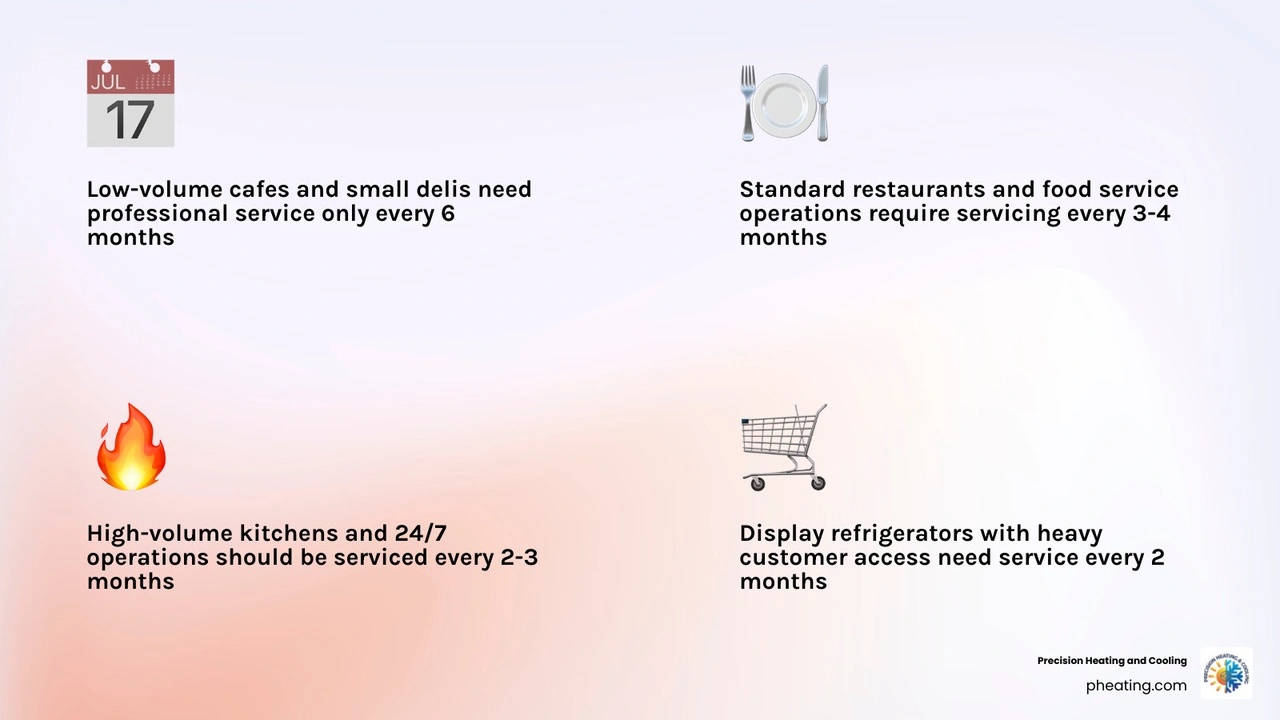
How often should commercial refrigeration be serviced depends on your business type, usage volume, and kitchen environment — but here is a quick breakdown to answer that right away:
| Operation Type | Recommended Professional Service Frequency |
|---|---|
| Low-volume (cafes, small delis) | Every 6 months |
| Standard restaurants and food service | Every 3-4 months |
| High-volume kitchens and 24/7 operations | Every 2-3 months |
| Display refrigerators with heavy customer access | Every 2 months |
| All operations (absolute minimum) | Twice per year |
Think about this for a moment. Your walk-in cooler does not care if it is a Saturday night dinner rush or a holiday weekend. When it fails, it fails. And by then, you are not just dealing with a repair bill — you are looking at spoiled inventory, potential health code violations, and lost revenue that is very hard to recover.
Commercial refrigeration units work far harder than anything in a residential kitchen. They run 24 hours a day, seven days a week, absorbing constant door openings, grease-laden air, and the heat generated by the rest of your kitchen. That kind of punishment accelerates wear on coils, gaskets, compressors, and electrical components faster than most operators realize. According to industry data, routine maintenance can reduce breakdowns by up to 90%, while dirty condenser coils alone can drive energy consumption up by 20 to 30 percent.
The good news is that a structured maintenance schedule — combining what your staff does daily with what a certified technician handles quarterly — can dramatically extend the life of your equipment and keep your energy bills in check.
I'm Tony Lara, an HVAC professional with hands-on experience diagnosing and maintaining commercial refrigeration systems, and understanding how often commercial refrigeration should be serviced is one of the most common and critical questions I help business owners answer. In the sections below, I'll walk you through everything you need to know to build a maintenance schedule that fits your operation.
When we talk about professional servicing, the general rule of thumb across the industry is to schedule a certified technician visit at least once every six months. However, that baseline is designed for light-duty, clean environments. For the vast majority of commercial kitchens, grocery stores, and food service businesses, a semi-annual schedule is simply not enough to prevent unexpected failures.
To establish a truly effective schedule, you must look at the specific demands placed on your machinery. Properly structured Walk-in Cooler Maintenance and comprehensive Preventative Refrigeration Maintenance can extend your equipment's lifespan by up to 50%, which translates to an extra 5 to 10 years of reliable service.
When you establish a preventative maintenance program, you shift your business from a reactive state of panic (waiting for a system to break down during a heatwave) to a proactive state of control. Regular checkups allow technicians to catch tiny issues — like a minor refrigerant leak, a worn motor bearing, or a slightly miscalibrated thermostat — before they cascade into catastrophic compressor failures.
Not all commercial refrigeration units are treated equally. The physical demands placed on a walk-in freezer in a high-volume restaurant in Clovis or Hanford are vastly different from those placed on a reach-in beverage cooler in a quiet corporate office in Palo Alto.
The primary driver of wear and tear is "door discipline" and the total volume of daily door openings:
To understand the mechanics behind how these different systems handle the strain, you can read our guide on Commercial Refrigeration Basics for Business Owners.
Where you place your refrigeration equipment plays a massive role in how quickly it degrades. A kitchen is a hostile micro-climate. It is filled with airborne grease, flour dust, high ambient heat from ovens, and fluctuating humidity levels.
Because of these harsh conditions, units positioned close to cooking lines may require condenser coil cleanings as often as twice a month, with professional checkups scheduled quarterly without exception. For tips on optimizing your kitchen layout to minimize these issues, check out our resource on the Proper Placement of Commercial Refrigeration Units.
There is a massive difference between your kitchen staff wiping down shelves and a certified technician performing a deep technical service. A professional refrigeration service visit is highly diagnostic, focusing on the internal thermodynamics and electrical systems of your equipment.
During a scheduled maintenance visit, our technicians perform a series of critical tasks designed to optimize performance and catch early warning signs of failure:
To help you visualize the division of labor in your business, here is a comparison table outlining what your team should handle versus what must be left to a licensed professional:
| Task Category | Staff Cleaning & Maintenance | Professional Technical Servicing |
|---|---|---|
| Coil Care | Weekly vacuuming or brushing of surface dust on accessible condenser coils. | Deep chemical cleaning of condenser and evaporator coils; straightening bent fins. |
| Gasket Maintenance | Daily visual inspection; wiping down door seals with warm, soapy water. | Replacing worn or torn gaskets; adjusting door hinges and latches for a tight seal. |
| Drainage System | Daily check for water pooling; wiping up spills immediately. | Flushing drain lines with specialized clearing agents; cleaning and sanitizing drain pans. |
| Thermodynamics | Daily temperature logging from external digital displays. | Testing refrigerant pressures; detecting leaks; calibrating sensors and thermostats. |
| Electrical Systems | Ensuring the unit is plugged in securely and power cords are undamaged. | Testing compressor amp draw; inspecting wiring, contactors, relays, and fan motors. |
| Airflow Management | Keeping products organized; maintaining 3-4 inches of clearance from walls and fans. | Testing evaporator fan motors; verifying correct CFM (cubic feet per minute) airflow. |
Even with a perfect preventative maintenance schedule, mechanical components can occasionally fail. As a business owner or kitchen manager, you and your staff must keep a close eye out for early warning signs. Ignoring these red flags can turn a simple, inexpensive fix into an emergency replacement.
If you are experiencing any of these issues right now, do not wait for your next scheduled service. We recommend reviewing our resources on Signs Commercial Refrigeration Requires Repair, Temperature Fluctuations Commercial Refrigeration Units, and Drainage Issues in Commercial Refrigeration Units to diagnose the problem quickly.
When business expenses rise, it can be tempting to push back your scheduled refrigeration service. However, skipping professional maintenance is not a cost-saving measure — it is simply a deferred expense that compounds over time. The financial risks of neglecting your cooling systems are incredibly high.
Investing in regular upkeep is like buying insurance for your inventory and peace of mind. For a deeper look into how professional care protects your bottom line, read our article on the Importance of Commercial Refrigeration Services. If your current units are already showing signs of severe wear and tear, our Commercial Refrigeration Upgrade Guide can help you decide if it is time to transition to newer, energy-efficient models.
While professional technical servicing is indispensable, your kitchen staff plays an equally vital role in keeping your refrigeration running smoothly. Creating a daily, weekly, and monthly checklist keeps your team accountable and catches minor issues before they escalate:
Daily Tasks:
Weekly Tasks:
Monthly Tasks:
Refrigeration systems are thermal exchange machines. Their job is to pull heat out of the food storage cabinet and dump it into the surrounding room.
When your condenser coils are dirty, they are covered by an insulating layer of dust, grease, and hair. This layer makes it incredibly difficult for the coils to release that heat. As a result, the refrigerant remains too warm, and the compressor has to run continuously, drawing massive amounts of electricity just to keep the cabinet cool.
According to industry data, just 0.01 inches of dust on a condenser coil can cut your system's operating efficiency by up to 20%. Regular professional cleanings remove this barrier, allowing the system to shed heat effortlessly, which drops your energy consumption and takes the strain off your compressor. If you are currently dealing with high energy bills or poor cooling performance, our Commercial Refrigeration Troubleshooting Guide 2025 provides excellent troubleshooting steps to help you pinpoint the source of the waste.
It helps to think of this in terms of car maintenance. Your staff cleaning is like washing your car, vacuuming the interior, and checking the tire pressure. It is essential for daily operations, hygiene, and overall appearance, but it does not keep the engine running smoothly.
Professional technical servicing is like taking your car to a certified mechanic for an engine diagnostic, oil change, and brake inspection. A licensed technician uses specialized tools to measure refrigerant pressures, test electrical currents, calibrate complex digital controls, and perform deep chemical cleanings of internal components that are sealed away from view.
Staff cleaning maintains sanitation and basic airflow, while professional servicing maintains mechanical, electrical, and thermodynamic integrity. To see exactly how our expert team approaches these complex technical procedures, check out our guide on How We Perform Commercial Refrigeration Repair.
Running a successful food service or retail business in the San Jose Bay Area or the Central Valley requires keeping your kitchen operating like clockwork. From Cupertino and Los Gatos to Clovis, Palo Alto, Santa Clara, Sunnyvale, and Hanford, your commercial refrigeration is the quiet engine driving your daily profitability and food safety compliance.
Knowing how often commercial refrigeration should be serviced is only the first step. The real magic happens when you partner with an experienced team to put that knowledge into action. At Precision Heating and Cooling, we bring over two decades of hands-on experience, competitive pricing, and flexible payment options to every job we tackle. We understand the unique demands of local commercial kitchens, and we are dedicated to providing the reliable, top-tier service your business deserves.
Do not wait for a hot summer day or a busy weekend shift to find out your walk-in cooler is struggling. Let us help you protect your inventory, lower your energy bills, and keep your kitchen running perfectly.
Schedule Commercial Refrigeration Services with Precision Heating and Cooling today, and let our expert team handle your preventative maintenance so you can focus on what you do best: running your business.

Leslie was amazing for her outstanding customer service skills with me the other day. Thanks to her help my air conditioner is now all set up. She answered all my questions and took away all my problems. Leslie broke it down step by step to set it up easier. Now thanks to her my air conditioner is working perfectly. I really appreciate it Leslie and I’ll be sure to ask for you if I ever come back.
I contacted Precision Heating and Cooling for my home's AC repair. They were punctual and very professional. Guillermo was very kind and thorough. I would highly recommend them!
I am writing to express my sincere appreciation for the excellent work performed by Pablo and Alejandro from Precision Heating and Cooling. Their commitment to quality and customer satisfaction is truly commendable. Awesome job guys!
I would like to extend my sincere gratitude to Alejandro for his exceptional hard work. His passion for helping others is evident, and he consistently goes above and beyond in his service. Alejandro's thorough cleaning of my fireplace has truly made a significant difference. His dedication and professionalism are greatly appreciated.
I was very impressed. Came at night (after 9pm) to fix our AC during the middle of a heat wave the day before a national holiday! Technician was very courteous and efficient, got the job done quickly. Will definitely call them again for any AC servicing I need!
Fast and efficient, arrived when scheduled for repairs and replacement parts were ordered and installed quickly. Techs were very friendly and professional. AC system works great now! I highly recommend their services if you need repairs. Tim


.avif)
