


.avif)






Recent Blogs
Stay updated with our latest blog posts.


How often should you service your HVAC system? Here is the quick answer most homeowners need:
| System Type | Recommended Service Frequency | Best Time to Schedule |
|---|---|---|
| Central Air Conditioner | Once per year | Spring (March–May) |
| Gas Furnace | Once per year | Fall (September–November) |
| Heat Pump | Twice per year | Spring and Fall |
| Systems 10+ Years Old | Twice per year minimum | Spring and Fall |
| Systems Under 5 Years | Once per year minimum | Spring or Fall |
Most HVAC professionals agree: twice a year is the gold standard — once before cooling season and once before heating season.
Now, here is why it matters more than most people realize.
Picture this: it is the middle of July in the San Jose Bay Area. Your air conditioner stops working. A technician finally arrives and tells you the whole breakdown could have been prevented with a basic annual tune-up. It is a frustrating situation — and an incredibly common one.
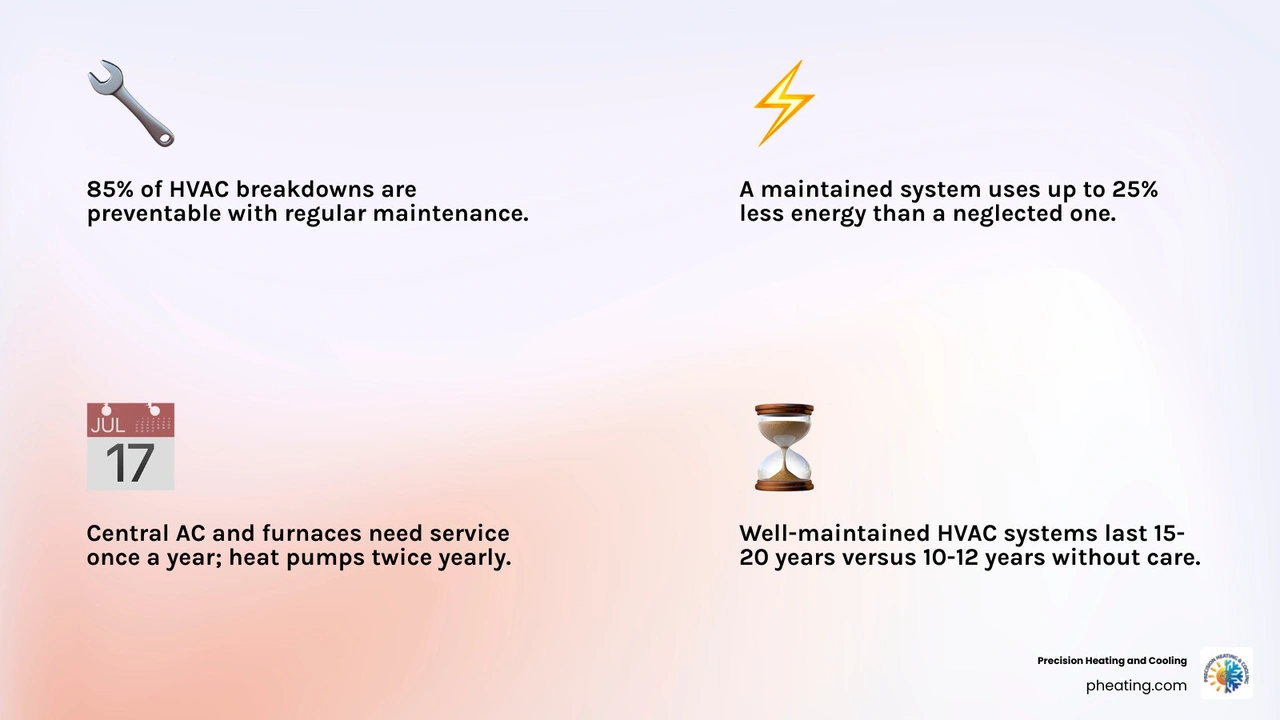
The data backs this up. Research shows that 85% of HVAC repairs are directly linked to a lack of proper maintenance. A neglected system can use up to 25% more energy than a well-serviced one, and it may last only 10 to 12 years instead of the 15 to 20 years a maintained system typically reaches. Regular service is not an optional extra — it is one of the smartest investments you can make in your home's comfort and your wallet.
Whether your system is brand new or pushing 15 years old, this guide walks you through exactly how often to schedule service, what affects that schedule, and what happens during each visit.
My name is Tony Lara, and through my hands-on experience in the HVAC field I have seen how a consistent maintenance schedule directly determines how often should you service your HVAC and how long your system will last. I look forward to helping you make sense of it all so your home stays comfortable year-round.
How often should you service your hvac glossary:
When we talk about the "gold standard" of HVAC maintenance, we are referring to a proactive schedule that keeps your systems running at peak performance. For homes with separate heating and cooling systems (such as a central air conditioner paired with a gas furnace), this means scheduling professional maintenance twice a year.
The strategy here is all about seasonal timing. You want to service each system right before it is forced to do the heavy lifting:
If your home uses a heat pump, the rules change slightly. Because a heat pump provides both heating and cooling, it operates year-round without a seasonal break. This constant operation subjects the system to double the wear and tear of a single-purpose unit.
For heat pumps, a bi-annual service schedule (once in the spring and once in the fall) is not just recommended; it is essential. Skipping a service interval on a heat pump means running a complex mechanical system for a full year of continuous operation without calibration, which dramatically increases the risk of a mid-season breakdown.
To dive deeper into the financial return on these seasonal visits, read our detailed analysis on Annual HVAC Maintenance Is It Worth It.
A common misconception among homeowners is that a brand-new heating and cooling system does not require professional attention. It is easy to think, "We just bought this system, so it should run perfectly for years without us touching it."
In reality, servicing a new system annually is critical for several key reasons:
For homeowners in the South Bay, keeping up with these early requirements is simple with our guide to San Jose HVAC Maintenance.
As your heating and cooling equipment moves through its life cycle, its maintenance needs will naturally evolve.
During this phase, minor wear and tear begins to accumulate. Electrical connections can loosen, electrical capacitors may begin to lose their charge, and blower motors might require lubrication. For mid-life systems, sticking strictly to a bi-annual schedule is the best way to prevent small, inexpensive wear-and-tear issues from turning into major component failures.
Once a system passes the decade mark, components like bearings, valves, and heat exchangers are nearing the end of their reliable operational life. For these systems, twice-yearly maintenance is your primary defense against sudden failure. These visits function as "damage control" and help us monitor the physical integrity of the system.
During these visits, we can help you calculate whether continuing to maintain the system makes financial sense. A good rule of thumb is the $5,000 rule: multiply the cost of a necessary repair by the age of the system. If the result exceeds $5,000, it is often more cost-effective to invest in a modern, energy-efficient replacement rather than continuing to patch up an aging unit.
While the standard recommendation is once or twice a year, your specific home and location can shift those needs. Several environmental and lifestyle factors play a major role in determining how often your system requires professional attention.
Our service areas span two distinct climate zones, each placing unique demands on HVAC systems:
If you share your home with pets, their dander and hair will inevitably find their way into your ductwork and onto your system's indoor coils. This restricts airflow and forces your system to work harder. Similarly, if anyone in your household suffers from asthma, severe allergies, or other respiratory conditions, you may need to service your system and change filters more frequently to keep your indoor air clean and healthy.
A professional HVAC tune-up is much more than a quick visual inspection. When our experienced technicians visit your home, they perform a comprehensive, multi-point check that takes between 60 and 90 minutes. Here is exactly what is included in a professional visit:
We inspect all electrical wiring for signs of wear, corrosion, or overheating. We tighten loose electrical connections and measure the voltage and current on motors. We also test the system's capacitors—which act as start-up batteries for your compressor and fan motors—since failing capacitors are the single most common cause of sudden AC breakdowns.
Dirty outdoor condenser coils and indoor evaporator coils are incredibly inefficient. Dirty coils alone can reduce your system's efficiency by 15% to 25% (and in severe cases, up to 40%). We clean the outdoor unit, remove any accumulated leaves or debris, and straighten bent coil fins to ensure unrestricted airflow.
Refrigerant operates in a closed, sealed system. It should never need to be routinely "topped off." If your system is low on refrigerant, it means there is a leak that must be located and repaired. We measure the refrigerant pressure and temperature to ensure the system is charged exactly to manufacturer specifications. A system low on refrigerant by just 10% can experience a 20% drop in operating efficiency.
This is the most critical part of a fall heating service. We inspect the gas valves, burners, and ignition systems. Most importantly, we examine the heat exchanger for any cracks. A cracked heat exchanger can allow toxic carbon monoxide gas to leak into your home's indoor air supply. We also verify that all safety limit switches are functioning properly to shut the system down if it begins to overheat.
To see a complete list of everything our technicians check during a standard maintenance call, view our resource on What Does an HVAC Maintenance Visit Include.
While professional servicing is essential for complex mechanical and electrical tasks, there are several simple maintenance steps that homeowners can—and should—perform themselves to keep their systems running smoothly between scheduled visits.
| Maintenance Task | Who Should Do It? | Recommended Frequency | Why It Matters |
|---|---|---|---|
| Replace Air Filters | Homeowner | Every 1–3 months | Keeps airflow strong; prevents dirt buildup on coils; dirty filters can raise energy bills by 5% to 15%. |
| Clear Outdoor Unit Debris | Homeowner | Monthly | Maintains at least 2 feet of clearance around the condenser for proper heat release. |
| Clear Condensate Drain | Homeowner / Professional | Monthly (DIY) / Annually (Pro) | Pouring vinegar down the drain line prevents algae clogs and water damage to your home. |
| Inspect Vents & Registers | Homeowner | Seasonally | Ensures furniture or drapes are not blocking supply or return airflow. |
| Electrical Diagnostics | Professional Only | Annually | Involves high-voltage components; dangerous if attempted without proper training and tools. |
| Refrigerant Handling | Professional Only | Only as needed | Requires EPA Section 608 certification under federal law. |
| Gas Line & Burner Adjustments | Professional Only | Annually | Prevents fire hazards and carbon monoxide leaks. |
Even if you stick to a regular maintenance schedule, unexpected issues can still arise. You should never ignore warning signs. If you notice any of the following "red flags," schedule a professional service call immediately rather than waiting for your next scheduled tune-up:
It is tempting to skip a year of service if your system seems to be running without any obvious issues. However, this is often a costly mistake.
Over a single year of neglect, your system will accumulate dust on its coils and blower components, causing a gradual drop in efficiency that translates directly to higher monthly energy bills. Small issues—like a weakening capacitor or a tiny refrigerant leak—will go unnoticed until they cause a complete system breakdown during the hottest or coldest week of the year.
Furthermore, skipping professional service can instantly void your manufacturer's warranty, leaving you unprotected if a major component fails.
For standard 1-inch pleated filters, we recommend checking them monthly and replacing them every 1 to 3 months. If you have multiple pets, live in a dusty area like parts of the Central Valley (such as Clovis or Hanford), or have family members with severe allergies, you should change them monthly.
If your system uses thicker 4-inch or 5-inch media filters, these can typically last 6 to 12 months before needing replacement.
Always choose a filter with a MERV (Minimum Efficiency Reporting Value) rating that is compatible with your specific system. High-MERV filters provide excellent filtration but can restrict airflow if your system's fan motor is not designed to handle the extra resistance.
Yes, for the vast majority of homeowners, a maintenance plan is highly cost-effective. These plans bundle your annual or bi-annual service visits at a discounted rate, saving you money compared to booking individual visits.
Most plans also offer valuable perks, such as priority scheduling during peak seasons (which is incredibly valuable during a summer heatwave) and discounts on any necessary repairs.
To learn more about how these plans work and find the right option for your home, check out our HVAC Maintenance Plans Guide or view the details of our own HVAC Maintenance Plan.
Keeping your heating and cooling systems properly maintained is the single best way to protect your investment, lower your monthly energy bills, and ensure your home remains comfortable year-round. While a standard annual checkup is the bare minimum, a bi-annual schedule remains the gold standard for most modern homes.
At Precision Heating and Cooling, we have spent over two decades helping homeowners throughout the San Jose Bay Area (including Cupertino, Los Gatos, Palo Alto, Santa Clara, and Sunnyvale) and the Central Valley (including Clovis and Hanford) keep their comfort systems running flawlessly. We pride ourselves on delivering highly reliable service, competitive pricing, and flexible payment options designed to fit any household budget.
Don't wait for your system to give you a reason to call. Schedule your professional HVAC service in San Jose today and let our expert team give you the peace of mind that comes with a perfectly tuned home comfort system.

Leslie was amazing for her outstanding customer service skills with me the other day. Thanks to her help my air conditioner is now all set up. She answered all my questions and took away all my problems. Leslie broke it down step by step to set it up easier. Now thanks to her my air conditioner is working perfectly. I really appreciate it Leslie and I’ll be sure to ask for you if I ever come back.
I contacted Precision Heating and Cooling for my home's AC repair. They were punctual and very professional. Guillermo was very kind and thorough. I would highly recommend them!
I am writing to express my sincere appreciation for the excellent work performed by Pablo and Alejandro from Precision Heating and Cooling. Their commitment to quality and customer satisfaction is truly commendable. Awesome job guys!
I would like to extend my sincere gratitude to Alejandro for his exceptional hard work. His passion for helping others is evident, and he consistently goes above and beyond in his service. Alejandro's thorough cleaning of my fireplace has truly made a significant difference. His dedication and professionalism are greatly appreciated.
I was very impressed. Came at night (after 9pm) to fix our AC during the middle of a heat wave the day before a national holiday! Technician was very courteous and efficient, got the job done quickly. Will definitely call them again for any AC servicing I need!
Fast and efficient, arrived when scheduled for repairs and replacement parts were ordered and installed quickly. Techs were very friendly and professional. AC system works great now! I highly recommend their services if you need repairs. Tim


.avif)
